


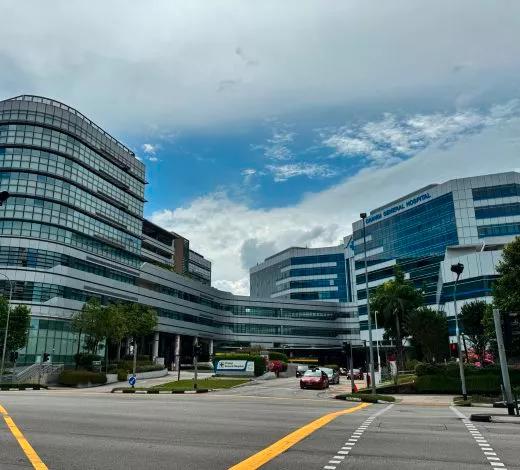
Changi General Hospital
Smart efficiency where precision matters most in healthcare.
Introduction
At Changi General Hospital in Singapore, a pilot project tested TA-Smart technology on one air handling unit (AHU-B1-5-4). The objective was to compare its smart control modes against conventional 2-way valve systems, with the goal of reducing chilled water energy use while maintaining precise indoor climate control.
The Hydronic Challenge
Hospitals face strict indoor climate requirements, operate 24/7, and are under increasing pressure to reduce energy consumption and meet sustainability targets. Rising energy costs and the need for reliable comfort in critical environments make chilled water systems a major challenge. The Changi General hospital needed a solution that could deliver measurable energy savings, reduce cooling loads, and improve system performance without compromising patient comfort or safety.
Solution
By applying TA-Smart’s advanced control logic and optimising flow and cooling output, the project achieved:
- Up to 17% energy savings on chilled water cooling
- 56% reduction in flow, improving pump efficiency
- 19% drop in cooling output, lowering peak load stress
- ΔT improvement of over 2°C, boosting chiller performance
In particular, TA-Smart’s power control mode, configured with optimised flow (1.20 l/s) and cooling output (22.5 kW), delivered the most impact, especially during early morning peak demand. This resulted in a more stable return air temperature (RAT) and enhanced control accuracy.
With smart flow limitation at start-up and better temperature differential, the AHU operated more efficiently, consuming less energy while ensuring reliable comfort.
If rolled out across all 157 AHUs at Changi General Hospital, the hospital could save over 674,000 kWh annually, with an ROI in just 33 months - well within the product’s 5-year warranty. Additionally, reduced cooling demand could allow operation with three chillers instead of four during peak periods, cutting both capital and operational costs.
This pilot confirms that intelligent hydronic control is feasible, scalable, and economically sound, driving sustainability and performance in one of the most demanding environments: healthcare.
Products installed: